Tag: Landscape Lighting

  • The Ultimate Fall Prep Guide for Your Outdoor Landscape Lighting in Ontario

    The Ultimate Fall Prep Guide for Your Outdoor Landscape Lighting in Ontario

    As school starts and autumn arrives, sunset times shift dramatically across Ontario, bringing shorter daylight hours and cooler temperatures. While fall foliage transforms properties with rich reds and golds, Ontario’s harsh upcoming winter, with freezing rain, heavy snow accumulation, and severe freeze-thaw cycles makes autumn the critical window for system maintenance. Taking time for proper fall prep ensures your outdoor lighting continues to deliver curb appeal, pathway safety, and reliable performance year-round.

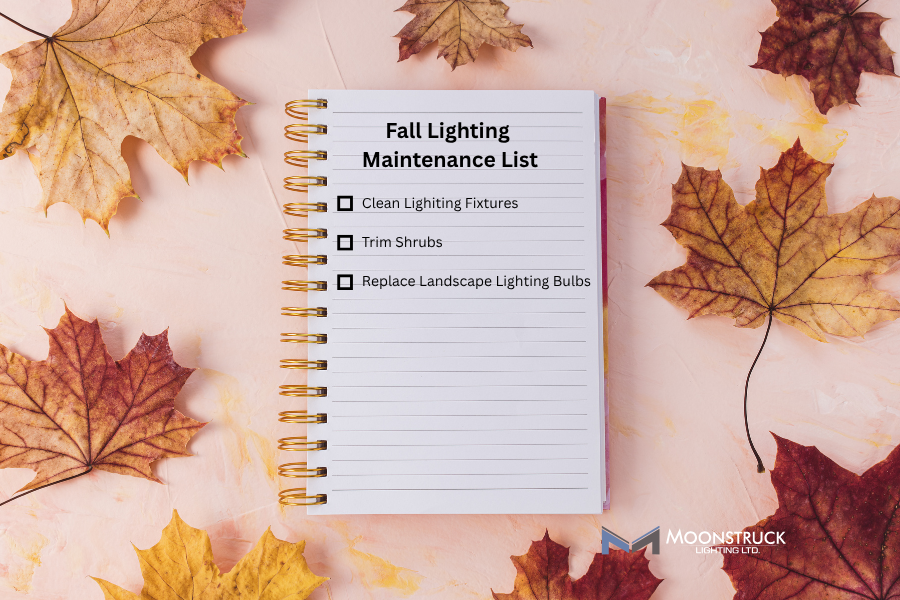
    The Essential Fall Maintenance Checklist

    Before the ground freezes solid in Ontario, performing routine checks on your low-voltage LED landscape lighting system will extend component lifespans and prevent costly winter damage.

    • Clear Leaves, Mulch, and Debris Off Fixtures: Accumulated fallen leaves, pine needles, and garden mulch can cover ground-buried fixtures, trap moisture, and block light distribution. Clearing debris prevents lens blockage and eliminates thermal traps that can degrade fixture housings.
    • Clean Fixture Lenses to Restore Full Brightness: Summer dirt, mineral deposits, and soil splatter leave a film on glass lenses. Washing lenses with mild soapy water removes grime and restores maximum lumen output across your landscape.
    • Inspect Trenching for Exposed Cables: Freeze-thaw cycles, soil shifts, and summer garden work can push direct-burial cables up toward the surface. Exposed wiring is vulnerable to lawnmowers, snow shovels, and frost heave damage. Under the Ontario Electrical Safety Code (OESC), low-voltage wiring must maintain proper trenching depth (15 cm to 45 cm) and be sleeved in rigid PVC conduit when passing under hardscapes or driveways.
    • Trim Overgrown Shrubs & Re-Aim Lighting for Autumn Canopies: Trim back overgrown branches that obscure light paths. Re-aiming fixtures allows you to showcase vibrant autumn leaves on specimen trees like Japanese Maples, Magnolias, and Birch, or highlight intricate branch silhouettes as leaves drop. Techniques like downlighting (“moonlighting”) – where fixtures mounted high in tree canopies cast soft light downward replicate natural moonlight filtering through branches.

    Adjusting Automation & Enhancing Fall Outdoor Living

    Shorter autumn days require adjustments to keep your outdoor living spaces warm, inviting, and secure.

    • Update Timers & Smart Control Schedules: As Toronto’s sunset times shift earlier each week, adjust your automated schedules or smartphone controls so entry sconces, driveway bollards, and path lights turn on before dark. This eliminates dark entryways and improves safety without resorting to harsh, blinding floodlights.
    • Leverage Warm 2700K Color Temperatures: Using 2700K warm white accent lighting brings out the rich red, orange, and golden hues of autumn foliage, transforming your yard into living art after dark.
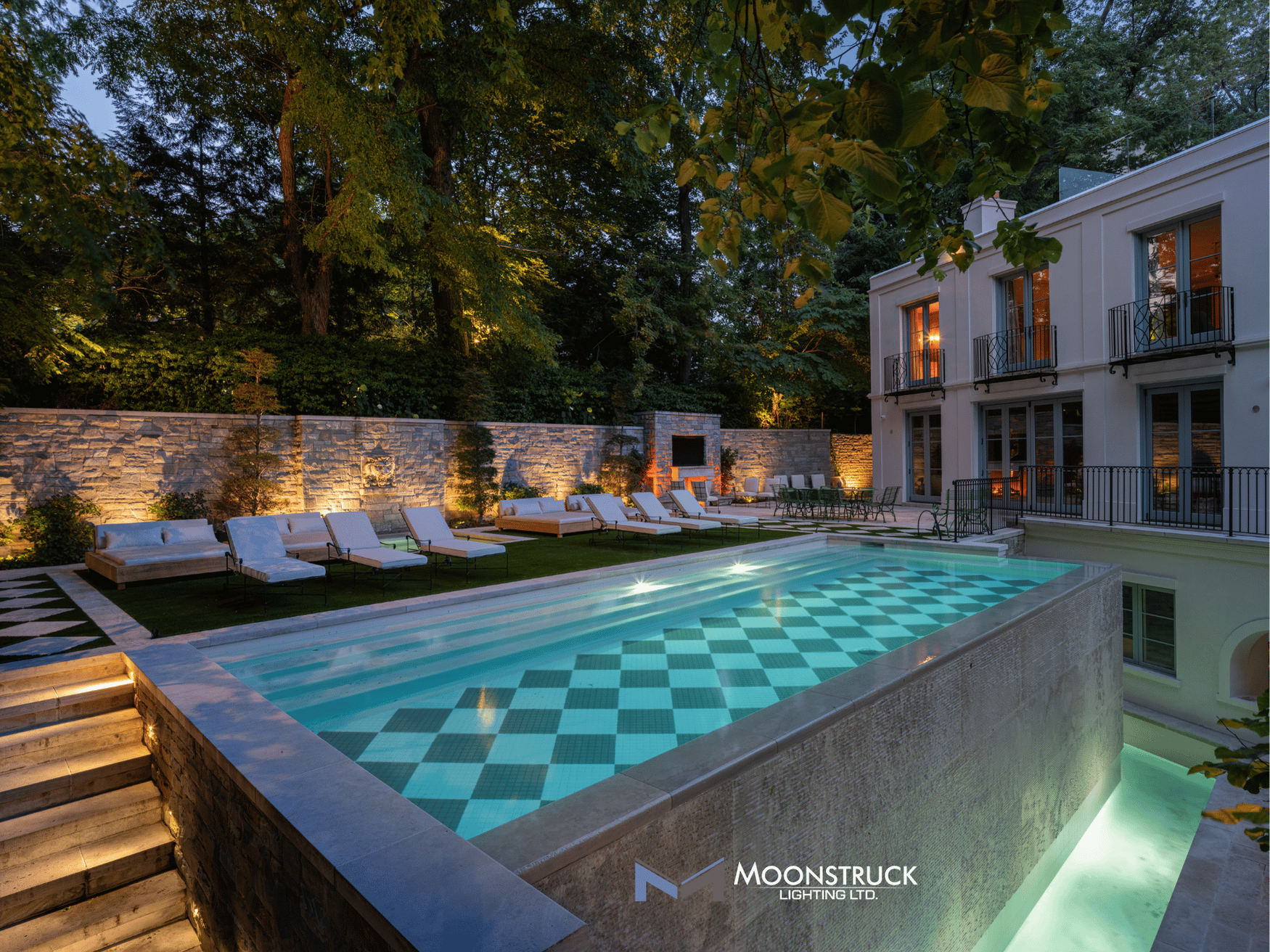
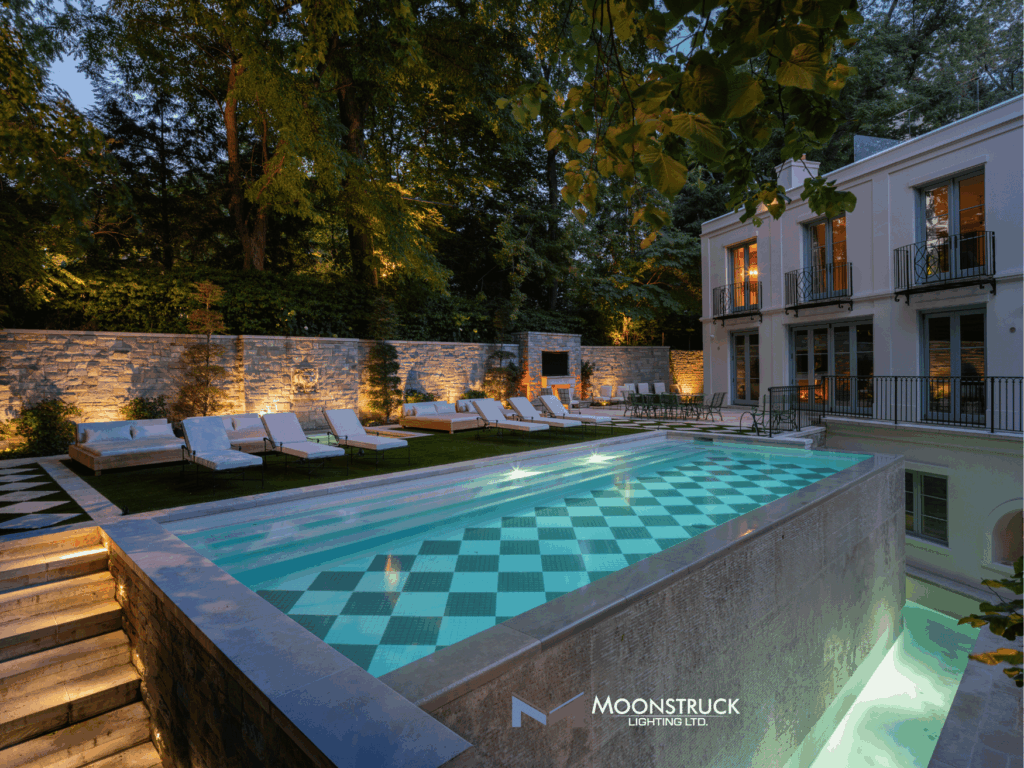
    • Extend Outdoor Patio Season with Integrated Hardscape Lighting: Low-glare step lights and under-cap LED strips recessed into retaining walls, stone steps, and poolside pavers create ambient, comfortable environments around fire pits and outdoor kitchens during crisp autumn evenings.

    Professional Electrical Standards & Winterproofing

    While low-voltage (12V) landscape lighting operates at a secondary voltage, the primary system connects directly to high-voltage residential electrical panels and exterior outlets exposed to damp Canadian soil and sub-zero temperatures.

    Moonstruck Lighting Ltd holds Authorized Contractor Program (ACP) status with Ontario’s Electrical Safety Authority (ESA), ensuring every project and service check adheres strictly to code:

    • The 80% Transformer Load Rule: Continuous electrical loads should never exceed 80% of a transformer’s maximum rated output to prevent thermal overload and internal circuit failure during temperature fluctuations.
    • Weatherproof GFCI Outlets: Primary connections must plug into exterior Class A Ground Fault Circuit Interrupter (GFCI) outlets protected by heavy-duty, wet-location-rated “Extra Duty” (while-in-use) cover plates to keep melting snow and rain out.
    • Submersible IP68 Splice Connections: Standard twist-on wire nuts absorb ground moisture and fail over time. Professional installations utilize IP68-rated, silicone-gel-filled connectors or gel-filled heat shrink tubing that form an airtight, fully submersible seal.
    • Durable Solid Cast Brass Fixtures: Store-bought plastic or thin aluminum fixtures corrode rapidly under road salt and freeze-thaw stress. Solid cast brass or marine-grade aluminum fixtures rated IP65 or higher are built to withstand harsh Ontario winters year after year.

    Why Work with Moonstruck Lighting Ltd?

    Did you know we offer an outdoor lighting maintenance program?  Landscape lighting is a specialized discipline requiring a combination of artistic vision and rigorous electrical engineering. Recognized with Awards of Excellence at the Landscape Ontario Awards Gala, Moonstruck Lighting Ltd delivers custom design, professional installation, and complete system servicing tailored to Toronto, the GTA, and Cottage Country properties.

    Prepare Your Property Before the Freeze With Moonstruck Lighting Ltd

    Don’t let early sunsets or incoming winter weather jeopardize your outdoor lighting system. Whether you need a comprehensive autumn system check, wire repair, fixture re-aiming, or an upgrade to permanent smart lighting, our team of ESA-certified electricians is ready to help.

    Ready to prepare your outdoor lighting for fall? Contact Moonstruck Lighting Ltd today to book your professional Fall Maintenance Service or schedule a design consultation.

    Founded in 1994, Moonstruck Lighting Ltd has delivered high-end landscape lighting design, installation, and electrical servicing across Toronto and the Greater Toronto Area (GTA) for over three decades.
  • Why You Need a Certified Electrician for Outdoor Landscape Lighting in Ontario

    Why You Need a Certified Electrician for Outdoor Landscape Lighting in Ontario

    Outdoor landscape lighting does far more than highlight your property’s best architectural features and extend your evening patio usability, it transforms your home’s security and curb appeal. However, many homeowners and general landscape contractors treat outdoor lighting as a basic aesthetic add-on, assuming that low-voltage (12V) systems carry zero risk.

    In Ontario, outdoor lighting installations interface directly with high-voltage residential electrical panels, exterior outlets, and harsh environmental elements. Failing to adhere to regional electrical codes or miscalculating power loads can result in premature system failure, property damage, and severe legal liability. Hiring a Licensed Electrical Contractor (LEC) certified by the Electrical Safety Authority (ESA) ensures your outdoor lighting system is reliable, safe, and code-compliant.

    Strict Compliance with Ontario Electrical Safety Authority (ESA) Standards

    In Ontario, all electrical work, including exterior architectural and landscape lighting is governed by the Ontario Electrical Safety Code (OESC). The law mandates that electrical installations be completed by a Licensed Electrical Contractor (LEC) holding an active ECRA/ESA license number.

    Permits and Notifications of Work

    Any line-voltage (120V) electrical connection, main breaker panel addition, or installation of new exterior receptacles legally requires a Notification of Work (electrical permit) filed with the ESA prior to beginning the project. Unlicensed handymen or general landscapers cannot legally pull these permits in Ontario, leaving your installation uninspected and undocumented.

    Class A GFCI Protection and Weatherproofing

    The primary high-voltage side of any landscape lighting transformer must plug into or connect to an exterior Ground Fault Circuit Interrupter (GFCI) outlet certified as Class A protection. Under Ontario code, exterior outlets must also utilize heavy-duty, wet-location-rated “Extra Duty” (while-in-use) cover plates. These enclosures ensure that transformer plugs remain completely protected from rain, melting snow, and garden hose overspray while in operation.

    Official Certificate of Acceptance

    Upon completing an inspection-eligible project, an ESA inspector evaluates the wiring, grounding, and connections. Only an LEC can issue an official ESA Certificate of Acceptance upon completion. This legal document proves to municipal inspectors, future home buyers, and insurance adjusters that all exterior electrical installations were completed safely and lawfully.

    Accurate Transformer Load & Voltage Drop Calculations

    Low-voltage LED landscape lighting systems operate on a 12-volt to 15-volt secondary circuit powered by a step-down transformer. While 12V currents carry a lower shock hazard than 120V household lines, poor system design quickly leads to flickering lights, dim fixtures at the end of runs, or transformer burnout.

    The 80% Safety Capacity Rule

    Transformers convert 120V household AC power into low-voltage DC/AC power. Continuous electrical loads should never exceed 80% of a transformer’s maximum rated output. For example, if a homeowner plans a multi-fixture layout drawing a combined 72 Watts of continuous power, standard engineering principles require a transformer rated for at least 90 Watts.

    Installing a 75W transformer for a 72W system pushes the unit to 96% capacity, causing ambient heat buildup, internal thermal tripping, and premature internal board failure during humid summer months.

    Managing Voltage Drop and Cable Topology

    Current traveling through copper wire encounters resistance over distance, causing the available voltage to drop steadily. On a 100-Watt circuit running 120 feet using standard 12/2 AWG wire, the voltage drops from 12V down to approximately 8.05V by the final fixture. Bulbs operating below 10.5V experience noticeable color shifting, dimming, and rapid LED driver failure.

    Certified electricians combat voltage drop through advanced circuit design

    Code-Compliant Trenching & Waterproofing Standards

    Ontario’s environment subjects underground wiring to extreme freeze-thaw cycles, high soil moisture levels, and physical disturbance from garden tools, lawn aerators, and root growth.

    Mandatory Wiring Burial Depths

    The OESC mandates specific trenching depths based on cable voltage and surface cover to prevent accidental cable severance:

    • Low-Voltage Cable (under lawns/gardens): Must be buried at least 15 cm to 45 cm deep depending on mechanical protection.
    • Line-Voltage Wiring (120V feed to transformers): Requires a minimum trench depth of 45 cm to 60 cm when using NMWU or direct-burial cables in non-vehicular areas.
    • Driveway & Hardscape Crossings: Cabling running under driveways or stone walkways must be sleeved inside rigid PVC conduit to protect the lines from heavy load compaction.

    Direct-Burial Standards and Waterproof IP68 Connections

    Generic extension cords or indoor-rated cabling quickly deteriorate when exposed to damp acidic soil, UV rays, and sub-zero temperatures. Certified installers use exclusively CSA-approved, sunlight-resistant UF-B or low-voltage direct-burial cable.

    Furthermore, standard twist-on wire nuts or electrical tape wrapped around wire splices fail within months under Canadian winter conditions, allowing water to wick up the copper strands into the fixture. Electricians utilize IP68-rated, silicone-gel-filled wire connectors or heat-shrink solder sleeves that form an airtight, fully submersible seal around every connection.

    Protecting Your Home Insurance Policy & Property Value With a Certified Electrician

    Outsourcing electrical work to uncertified handymen or doing high-voltage exterior wiring as a DIY project introduces severe financial exposure.

    Risk of Denied Property Insurance Claims

    Under standard Ontario residential insurance policies, policyholders are obligated to maintain property safety and comply with local building and electrical codes. If an unpermitted 120V exterior connection or overloaded transformer leads to an exterior wall fire, electrical short, or property damage, insurance adjusters routinely investigate whether an ESA permit was issued. Work completed by an unlicensed installer can serve as grounds for denied insurance claims, leaving the homeowner personally liable for damages.

    Common DIY vs. Certified Electrician Installation Pitfalls

    Mistake / FeatureUnlicensed / DIY SetupCertified Electrician Solution
    Splice WaterproofingStandard twist-nuts or electrical tape that absorb ground moisture.IP68-rated silicone-gel connectors or gel-filled heat shrink tubing.
    Power Supply SourceSpliced into indoor circuits or plugged into ungrounded outlets.Dedicated exterior GFCI receptacle with an “Extra Duty” cover.
    Trenching DepthShallow placement exposed to aerators, shovels, and frost heaves.Trenched to OESC depth specifications and sleeved under hardscapes.
    Transformer SizingOperating near 100% capacity, risking thermal breakdown.Sized with an 80% continuous load cap for long-term reliability.

    Investing in professional outdoor lighting elevates your property’s security, accessibility, and architectural beauty while maintaining rigorous safety standards. Moonstruck Lighting Ltd delivers fully licensed, ESA-compliant landscape lighting design, installation, and electrical servicing across Toronto and the Greater Toronto Area. Contact Moonstruck Lighting Ltd today to schedule a consultation with an ESA-certified electrician.

  • Low Voltage Landscape Lighting vs. Solar: Which Is Right for Your Toronto Area Home?

    Low Voltage Landscape Lighting vs. Solar: Which Is Right for Your Toronto Area Home?

    When planning outdoor illumination for your property, one of the first major decisions you’ll face is choosing between low-voltage wired landscape lighting and solar-powered fixtures.  While both options aim to brighten your paths, gardens, and architectural features after dark, they operate on vastly different technology, delivering dramatically different results in performance, durability, and visual appeal.

    Here is an honest breakdown of how low-voltage landscape lighting compares to solar power, helping you decide which investment makes sense for your property.

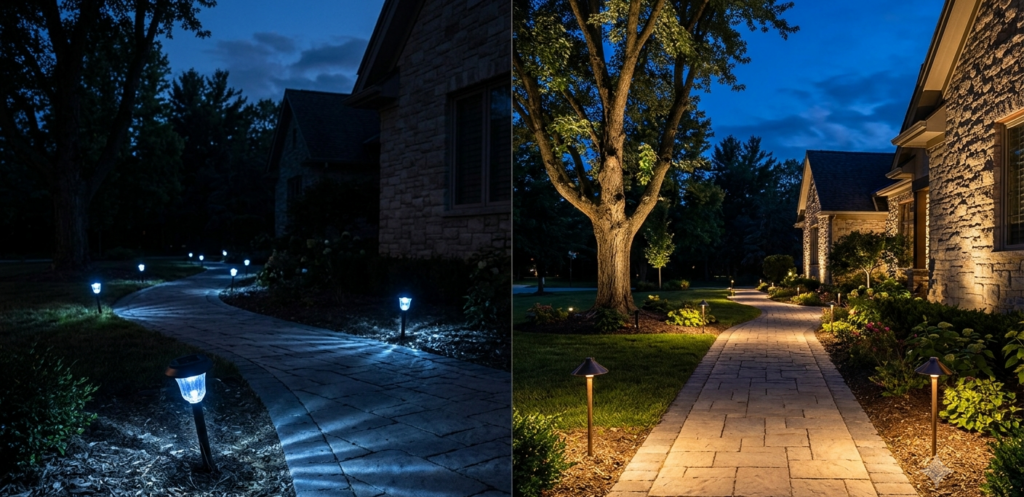
    Solar vs Low Voltage Lighting - Premium Landscape Lighting Toronto - Moonstruck Lighting Ltd.

    1. Brightness and Light Quality (Lumens)

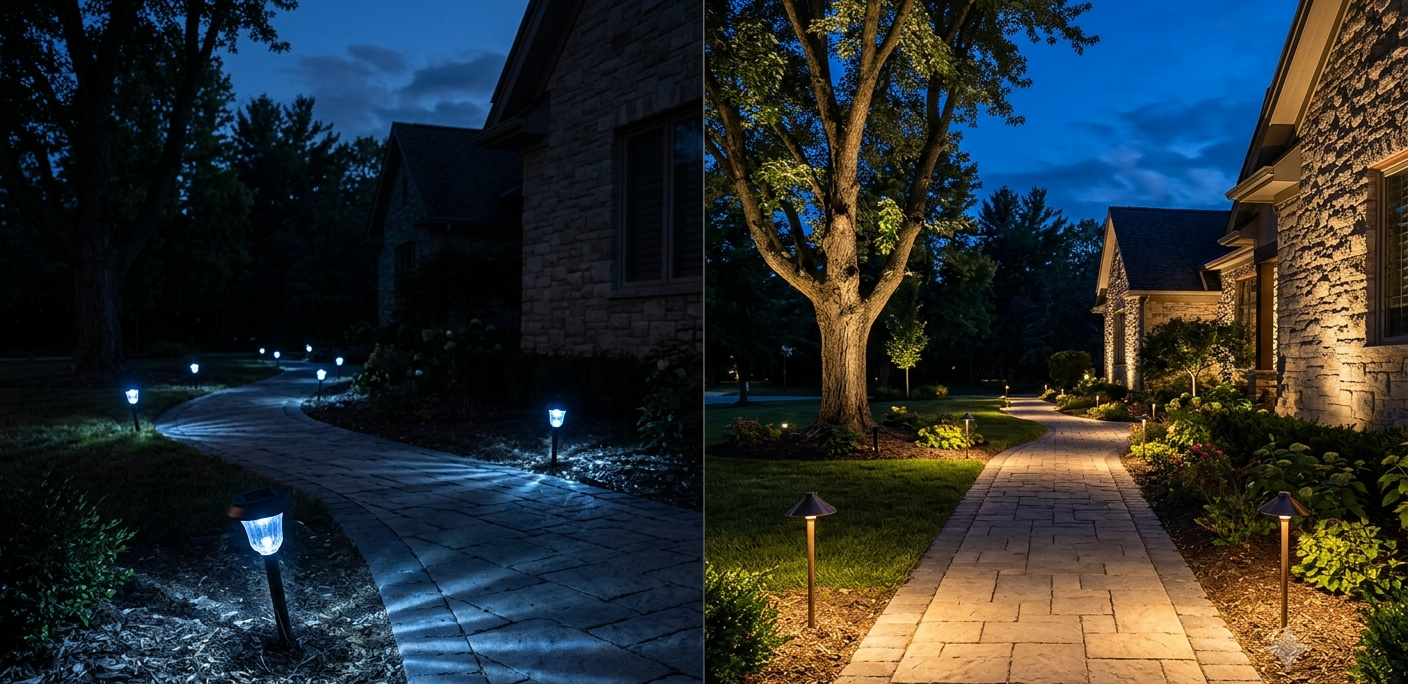
    • Low Voltage (12V LED): Low-voltage systems draw power from a central transformer connected to your home’s electrical supply. This guarantees a consistent output of high-grade light. A typical low-voltage LED fixture outputs between 200 to 800+ lumens, allowing for precise warm-white color tuning (typically 2700K to 3000K), broad coverage, and controlled beam angles that highlight tall trees or stone facades.
    • Solar: Solar lights rely entirely on internal rechargeable batteries charged by daylight. Most consumer solar lights produce only 10 to 50 lumens, providing a soft indicator glow rather than functional illumination. Furthermore, solar LEDs often throw a cool, blue-ish light (5000K+) that can look harsh against natural greenery and masonry.

    2. Reliability and Seasonality

    • Low Voltage: Rain, snow, cloud cover, or winter shadows have zero effect on low-voltage performance. Your lights will turn on reliably at twilight at 100% brightness every single night, 365 days a year.
    • Solar: Solar fixtures require 6 to 8 hours of direct, unobstructed sunlight to achieve a full charge. During overcast days, shorter winter days, or in heavily shaded garden beds, solar lights will either fade after a couple of hours or fail to turn on altogether.

    3. Lifespan and Materials

    • Low Voltage: Professional-grade low-voltage fixtures are crafted from solid architectural metals, such as cast brass, copper, or aircraft-grade aluminum. Paired with sealed LED modules, a well-designed low-voltage system is built to withstand extreme freeze-thaw cycles and lawn maintenance equipment, lasting 15 to 20+ years with basic maintenance.
    • Solar: Most solar lights feature plastic housings and integrated lithium-ion batteries exposed to severe outdoor temperature swings. Because solar batteries degrade after 1–2 seasons of continuous charging cycles, the fixtures usually need complete replacement every couple of years.

    4. Design Flexibility & Architectural Impact

    • Low Voltage: Because fixtures are wired back to a single power source, lighting designers can create complex, layered scenes. You can integrate subtle uplighting under tree canopies, low-profile step lights along hardscapes, underwater pond fixtures, and discreet downlights.  All can be synchronized on a single smart control system or timer.
    • Solar: Solar fixtures must be placed wherever the sun hits directly, not necessarily where lighting looks best. This severely limits design potential, forcing fixtures into sunny, exposed areas rather than under dense pergolas or covered patios.

    Low Voltage vs. Solar: Quick Comparison

    FeatureLow-Voltage Wired LED (12V)Solar-Powered Lighting
    Average Output200 – 800+ Lumens (High brightness)10 – 50 Lumens (Low accent glow)
    All-Weather Reliability100% reliable year-roundVariable (Dependent on sunlight & season)
    Color TemperatureWarm, natural white (2700K – 3000K)Cool, blue-tinted white (5000K+)
    System Lifespan15–20+ Years (Solid brass/copper)1–3 Years (Plastic & internal batteries)
    Design FlexibilityUnlimited (Shade, trees, hardscapes)Limited (Requires direct sunlight)
    Ideal ForFull property designs, safety, luxury appealTemporary accent paths, small DIY garden beds

    The Verdict: Which Should You Choose?

    • Choose Solar If: You want a low-cost, temporary DIY solution for a small garden path, live in a rented home, or need quick accent lighting in an open, sun-drenched area without running wires.
    • Choose Low-Voltage If: You are looking to elevate your property’s curb appeal, secure dark entryways, highlight architectural masonry, or create an outdoor living space that functions seamlessly after dark year-round.

    While solar lights offer convenience for minor DIY projects, low-voltage lighting remains the gold standard for long-term beauty, security, and property value.

    Transform Your Outdoor Space with Moonstruck Lighting Ltd.

    At Moonstruck Lighting Ltd., we design and install bespoke low-voltage landscape lighting systems engineered to perform in all seasons. Backed by Master Electricians and certified design professionals, our tailored lighting setups bring out the true beauty of your home and landscape.

    Ready to see your property in a whole new light?

    Contact Moonstruck Lighting Ltd. today to schedule a consultation with our outdoor lighting specialists.

    FAQS – Low Voltage Light vs Solar

    1. Do low-voltage landscape lights consume a lot of electricity?

    No. Modern low-voltage landscape lighting uses energy-efficient LED bulbs operating on 12 volts rather than standard 120-volt household current. Running a typical 10-to-15 fixture LED system for 6 hours a night usually adds only $2 to $5 per month to your electric bill.

    2. Why are solar landscape lights so dim compared to low-voltage lights?

    Solar fixtures rely on tiny built-in solar panels and small internal batteries that must conserve energy to last through the night. As a result, solar lights usually output only 10 to 50 lumens (a faint accent glow). Low-voltage LED fixtures draw continuous power from a transformer, producing 200 to 800+ lumens of rich, steady illumination.

    3. Can low-voltage landscape lighting be added to existing hardscapes and mature yards?

    Yes. Professional installers use specialized trenching and wire-burying techniques that leave lawns, gardens, and flower beds virtually undisturbed. Wires can also be concealed under retaining wall caps, along patio edges, and under deck stairs without damaging existing structures.

  • How to Use Concealed Lighting to Turn Your Toronto Backyard into a Boutique Resort

    How to Use Concealed Lighting to Turn Your Toronto Backyard into a Boutique Resort

    Toronto summers are famously short, which means GTA homeowners know how to value every single square inch of patio season. We invest heavily in sleek composite decks, custom stone outdoor kitchens, and pristine horizontal privacy fences.

    But what happens when the sun goes down?

    If your current setup relies on a blinding security floodlight or a few cheap plastic stakes that look like solar-powered mushrooms, you are missing out on the ultimate backyard upgrade. The world’s finest boutique resorts don’t blast their guests with raw glare; they use concealed lighting to create an ambient, deeply relaxing oasis.

    Here is how you can use the “invisible glow” trend to bring that exact five-star resort energy to your Toronto property.

    Concealed Lighting - Landscape Lighting Toronto - Moonstruck Lighting Ltd

    What is Concealed Lighting?

    Concealed lighting, often called integrated or hardscape lighting, is the art of hiding the actual light fixture while showcasing only the beautiful illumination it produces.

    Instead of seeing a bulky metal cone sitting on your lawn, you see a soft wash of light cascading down a stone retaining wall, or a gentle glow radiating from beneath your deck steps. It creates an organic, sophisticated atmosphere that makes outdoor spaces feel larger, warmer, and infinitely more luxurious.

    4 Ways to Get the Boutique Resort Look

    Ready to upgrade your outdoor living space? Focus on these four high-impact areas to seamlessly blend hidden illumination into your landscape design.

    1. Under-Cap Lighting for Retaining Walls & Outdoor Kitchens

    If you have a stone outdoor kitchen, a fire pit feature, or retaining walls separating your patio tiers, this is your secret weapon. Low-profile linear LED fixtures are tucked directly beneath the overhanging stone “cap.”

    • The Effect: It creates a “floating” illusion, making heavy masonry look weightless while casting a beautiful downward glow that highlights the natural texture of the stone.

    2. Flush Integrated Paver Lights

    Forget tripping over pathway lights while hosting a backyard cocktail party. Integrated paver lights are embedded completely flush with your stonework, driveway, or pool deck.

    • The Effect: During the day, they are entirely invisible and completely flat (meaning you can walk or run a lawnmower right over them). At night, they provide a clean, modern starlit trail that safely guides guests without disrupting the view.

    Pro Tip: When planning integrated paver lights, stick to a warm color temperature (around 2700K). Anything higher than 3000K will look like a commercial parking lot or an airport runway rather than a cozy resort.

    3. Hidden Step and Stair Risers

    Safety and luxury rarely go hand-in-hand so perfectly. By concealing LED strip lights or small eyebrow fixtures under the lip of your deck stairs or stone steps, you illuminate the tread of the stair perfectly.

    • The Effect: It removes the risk of trips in the dark while washing your staircases in a soft, welcoming light that mimics luxury hotel entryways.

    4. Subtle “Fence-Washing”

    Instead of aiming bright spotlights outward into your yard, mount slim, shielded fixtures to the posts of your privacy fence, directing the light straight down.

    • The Effect: This creates a rhythm of soft light and shadow along your property line. It establishes a warm boundary, makes your yard feel grander, and prevents light from spilling over into your neighbor’s windows.

    Traditional vs. Concealed Lighting: A Quick Comparison

    If you are debating which style fits your upcoming landscape renovation, consider how they stack up:

    Lighting FeatureTraditional Path/SpotlightsConcealed Hardscape Lighting
    Fixture VisibilityHigh (Stakes and cones are visible during the day)Zero (Fixtures are completely hidden from sight)
    Glare LevelMedium to High (Can cause eye strain if misdirected)None (Light source is shielded, only the glow is visible)
    DurabilityVulnerable to lawnmowers, snow shovels, and petsHighly protected inside stone, wood, or concrete
    Design AestheticClassic / TraditionalModern / Ultra-Luxury / Resort-Style

    Built to Survive the Toronto Climate

    Designing a luxury backyard in the GTA requires a dose of practical reality: our winters are brutal. Freezing rain, heavy snow accumulation, and sub-zero temperatures will quickly destroy cheap materials.

    When investing in concealed lighting, ensure your contractor uses fixtures rated IP65 or higher (completely dust-tight and water-resistant). Opt for solid, heavy-duty materials like cast brass or marine-grade aluminum rather than plastic composites. Because these fixtures are embedded directly into your hardscaping, you want components that are built to last as long as the stone surrounding them.

    Bring the Vacation Home

    You don’t need to catch a flight to experience a high-end boutique atmosphere. By shifting the focus from how many lights you can see to how the light behaves, you can transform your backyard into a private evening sanctuary right here in Toronto. 

    Looking for help with your landscape lighting design?  Contact Moonstruck Lighting Ltd for a consultation.

  • Glowing Up Your Outdoor Space: The Complete Guide to Toronto Landscape Lighting Maintenance and Upgrades

    Glowing Up Your Outdoor Space: The Complete Guide to Toronto Landscape Lighting Maintenance and Upgrades

    There is nothing quite like the magic of a well-lit landscape. When the sun sets, professionally designed outdoor lighting can transform your yard into a warm, inviting oasis while boosting curb appeal, safety, and property value.

    However, even the best landscape lighting systems need regular maintenance and occasional upgrades to perform at their best. If your lights are starting to look dim, uneven, or outdated, this guide will walk you through everything you need to know about maintaining and upgrading your landscape lighting in Toronto and beyond.

    Why Landscape Lighting Maintenance Matters

    Outdoor lighting systems are constantly exposed to the elements—rain, snow, dirt, and temperature fluctuations can all take a toll. Without proper upkeep, even high-quality systems can lose brightness, shift out of place, or stop working efficiently.

    Regular maintenance helps:

    • Preserve brightness and clarity
    • Extend the lifespan of fixtures and bulbs
    • Prevent costly electrical issues
    • Maintain safety along walkways and entrances
    • Keep your home looking polished and well cared for

    Signs It’s Time to Upgrade Your Landscape Lighting

    Even with proper maintenance, older systems can become inefficient or outdated. If your lighting no longer delivers that “wow” factor, an upgrade can dramatically improve both aesthetics and performance.

    You’re Still Using Halogen Bulbs
    Halogen systems are energy-intensive and require frequent bulb replacements. Modern LED landscape lighting uses up to 80% less energy and can last 15–20 years, making it a smart long-term investment.

    Your Lighting Looks Dim or Uneven
    If certain areas of your yard look dull or inconsistent, your system may be struggling with voltage drop or aging components.

    You Want Smart Control and Automation
    Smart landscape lighting systems allow you to:

    • Control lights from your smartphone
    • Set automated schedules for seasons or events
    • Adjust brightness and zones
    • Improve energy efficiency with precision control

    Your Outdoor Space Has Changed
    Adding a patio, pool, garden, or outdoor kitchen? Your lighting should evolve too. Expanding your layout ensures your entire outdoor living space feels cohesive, functional, and inviting.

    Popular Premium Landscape Lighting Upgrades for Modern Homes

    Upgrading your system is not just about efficiency, it is also about creating a more immersive outdoor experience.

    • LED conversions for energy savings and longevity
    • Pathway lighting for safety and curb appeal
    • Accent lighting to highlight trees, stonework, and architecture
    • Deck and step lighting for functionality and ambiance
    • Smart Wi-Fi controllers for full customization

    Call a Lighting Expert

    Simple maintenance tasks can be tedious. Additionally, more complex work should be handled by professionals to ensure safety and optimal performance.

    Call a lighting expert if you need:

    • Electrical troubleshooting or rewiring
    • LED system conversions
    • Lighting design for new landscaping
    • Transformer upgrades or load balancing
    • Long-term maintenance plans to ensure ongoing system performance and safety

    How Moonstruck Lighting Can Transform Your Property

    At Moonstruck Lighting, we go beyond basic installation, we design outdoor environments that feel as stunning at night as they do during the day.

    Comprehensive System Audits
    We inspect every component of your system, from transformers to wiring, ensuring everything is safe, efficient, and performing at its best.

    Seamless LED Upgrades
    We convert outdated systems into modern, energy-efficient LED setups that deliver warm, consistent, and beautiful illumination.

    Custom Landscape Lighting Design in the GTA
    Our team creates tailored lighting plans that enhance depth, highlight key features, and elevate your home’s nighttime aesthetic.

    Ongoing Maintenance Services
    Keep your system in peak condition year-round with professional maintenance that protects your investment and preserves your curb appeal.

    Ready to Upgrade Your Landscape Lighting?

    Do not let your beautiful outdoor space disappear after sunset. With the right maintenance and modern upgrades, your landscape lighting can continue to impress for years to come.

    Contact Moonstruck Lighting today to schedule your maintenance service or design consultation and bring your outdoor space to life after dark.